You have chosen a project and seen the floor plans. The step in front of you is your first large payment: a pre-construction condo deposit in Miami, due long before the building is finished.
That raises a fair question, and not a comfortable one: where does the money go while there is no home yet?
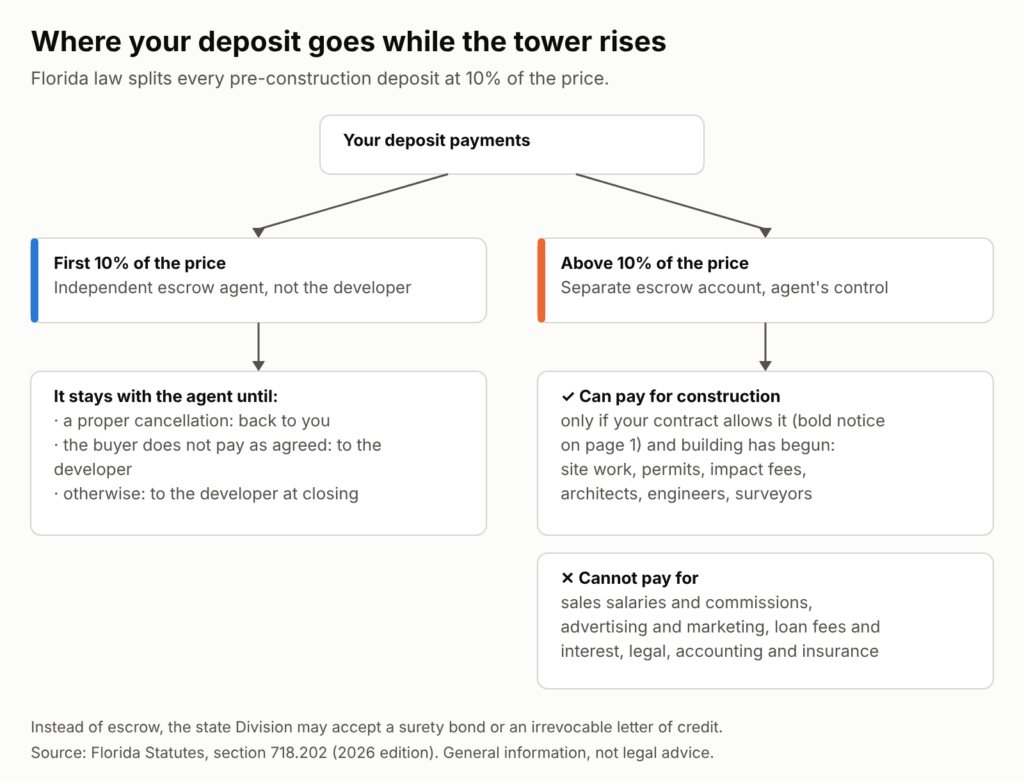
The short answer: under Florida law, the first 10% of the price goes to an independent escrow agent, not to the developer, and anything above 10% sits in a separate account under rules the law sets. This guide walks through how each part works, from the payment steps to the papers to have before you sign. It does not recommend a project.
If you already have a project in mind, email me, message me on WhatsApp or call +1 305-874-9500, and we can go through its schedule and documents together.
You buy from plans and move through five steps: an optional reservation, the developer’s filing of its documents with the state, the purchase contract, payments at construction milestones, and closing when the building is complete.
In the projects quoted here, payments are tied to signing, groundbreaking, top-off (the day the structure reaches its top floor) and closing. The percentages differ by project, as the published schedules below show. A reservation holds a place before the contract, and its deposit goes to an escrow agent.
Before the contract, the developer files its documents with the Division of Condominiums. For a condo with more than 20 residential units, they include a prospectus, a disclosure booklet the developer has to give you. According to the Division’s own FAQ, filing is for compliance and disclosure and does not mean the Division has signed off on the offering. The state, then, holds the same set of papers the developer must hand to you.
You choose your residence from the full set of plans, and in two of the published schedules the larger part of the price is paid when the home is finished.
Rivage Bal Harbour’s official website carries a fact sheet (early 2024) that describes a 25-story tower with private-elevator entry to each residence. It has 56 homes with 10-foot ceilings. Amenities span 25,000 square feet, with a spa, a fitness pavilion with ocean views and a fully serviced beach club. Prices start at $8,000,000.
With 56 homes in the whole tower, each has its own plan and its own private-elevator entrance. When sales open, no unit has been sold yet, so the full set of plans is yours to choose from.
Your choice is fixed on paper: for a condo with more than 20 residential units, the prospectus includes the floor plan of your unit and a plot plan showing where the buildings and common areas stand. That floor plan is part of the documents themselves.
On the money side, two of the schedules in the table below, Rivage and Perigon, put 60% at closing or completion. So 40% is paid before the keys, in steps tied to construction stages rather than in one sum.
For the pace of sales, take 7200 Collins in Miami Beach, which has 222 residences. According to the project materials, the building was 93% sold less than a year after sales launched (Florida YIMBY, March 2026). Related says Casa Bella’s sell-through was above 95% as closings began (The Real Deal, October 2026).
The market around these towers is large. ISG World’s report counted about 115 condo projects in preconstruction across downtown Miami, Miami Beach and Broward. Those projects hold nearly 18,000 residences. Bisnow summarized the report in July 2026; it covers the first quarter of that year.
Even so, the size of the market does not tell you how long a particular line (the same unit position, floor after floor) in a particular tower will stay open: the choice is wide between buildings and narrows inside one building as sales go on.
I tell buyers to name the line or floor they want in the first conversation. The earlier that conversation, the more plans are still open.
The seven published schedules below differ in how many payments there are and in how much comes before closing; the year in parentheses is when the source was published.
| Project | Schedule as published |
|---|---|
| Rivage Bal Harbour, Bal Harbour (2024) [1] | 20% at contract, 10% at groundbreaking, 10% at top-off, 60% at closing |
| Casa Bella Residences, Miami (2025) [2] | 20% at signing, 10% at groundbreaking (done in 2023), 10% at top-off, the rest at closing |
| Perigon Miami Beach (2026) [3] | 30% by groundbreaking, 10% at top-off, 60% at completion |
| Residences at Six Fisher Island (2023; units from $15 million) [4] | 50% non-refundable deposit at presale |
| Estates at Acqualina (2020), Sunny Isles Beach (south tower units $4.6 million to $11 million, one penthouse $31 million) [5] | 45% deposit requirement |
| E11even Hotel & Residences Miami (2021) [6] | 10% non-refundable deposit, 30% more before closing, the rest at closing |
| E11even Residences Beyond, Miami (2021) [7] | 30% deposits placed, another 10% due one year after groundbreaking |
Sources for the rows: 1. Rivage Bal Harbour fact sheet, project’s official website, January 2024; 2. HR Ratings, a credit rating agency, Casa Bella Residences report, October 2025; 3. HR Ratings, 5333 Collins (The Perigon) annual review, June 2026; 4. CNBC, January 2023; 5. The Real Deal, February 2020; 6. The Real Deal, April 2021; 7. The Real Deal, November 2021.
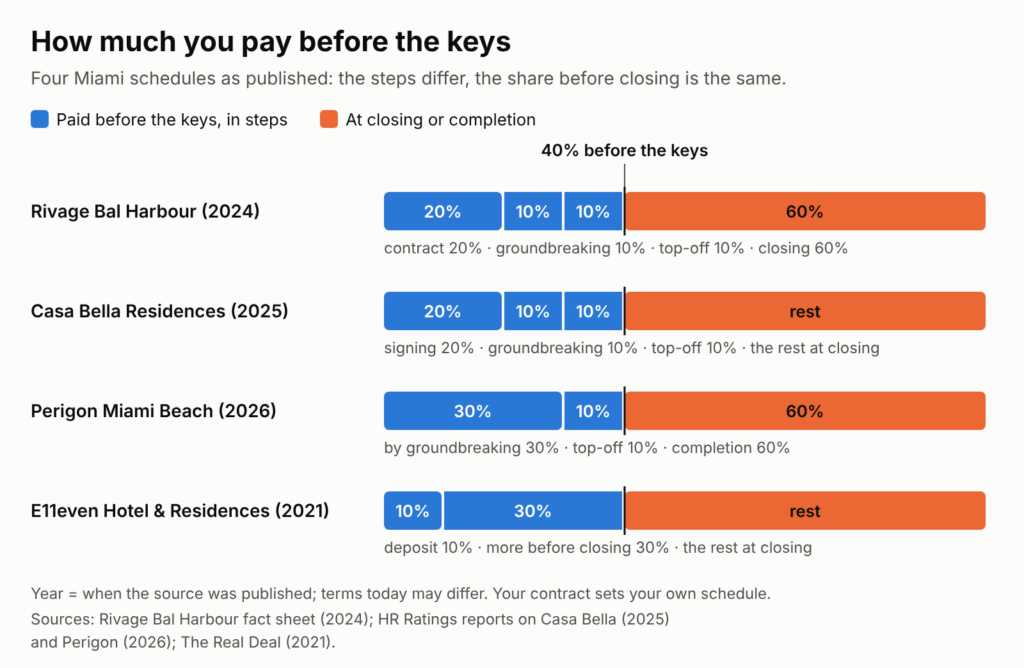
These rows show how Miami projects set out their schedules on the date of publication; terms today may differ. What binds you is the schedule written into your contract. A rating agency passes a schedule along as the developer reported it, and a row from a news report gives the figures named to a reporter that day. The word “non-refundable” in two rows is the sources’ wording; what happens to a deposit in a given purchase is set by the contract.
MIAMI REALTORS notes in its monthly market report that new-construction and pre-construction sales are largely not reported in the MLS, so the public MLS numbers leave them out (August 2026). Public statistics barely see the market you are buying in, which is why this guide works from each project’s own documents.
When I go through a schedule with a client, I put every payment and its date on one sheet. With every date in front of you, you can start planning how to fund each step.
If you have a project in mind, send its schedule to me by email or WhatsApp, or call me at +1 305-874-9500. We’ll set it out in dollars for the unit you are looking at.
Your first 10% goes to an independent escrow agent, not to the developer, and money above 10% sits in a separate escrow account under rules on what it may pay for before closing.
An escrow agent is a neutral third party that holds money until a deal closes. The law lists who can serve, from banks to title insurers, and rules out the developer, its officers, affiliates and employees. Your contract names the agent and gives an address, and the agent issues a receipt on request.
Where a developer offers a reservation, its deposit goes to an escrow agent, who gives you a receipt, and on your written request it is refunded in full. It reaches the developer only as a down payment once a contract is signed, and from then on the escrow rules apply.
You may read that the whole deposit sits untouched in escrow until closing. The law is more precise: the first 10% stays with the agent, and money above it sits in a separate escrow account under the agent’s control. Before closing, that money can go toward construction, if your contract allows it and building has begun.
Construction here means the work of building: site clearing and demolition, permits and impact fees, fees to reserve utilities, and the work of architects, engineers and land survey crews. It does not mean selling the units: no salaries or commissions for sales staff, no advertising or marketing. Loans are off the list too, from loan fees to interest, and so are legal, accounting and insurance costs.
A contract that allows this use says so in a bold notice on its first page, right above your signature, so you see the choice when you sign.
Instead of escrow, the Division can accept other guarantees, such as a surety bond or an irrevocable letter of credit, in an amount equal to what escrow would hold.
Three things: 15 days to cancel after you sign and receive the documents, the right to cancel if the deposit rules are not followed, and the dates written into your contract.
You can cancel in writing within 15 days after you have signed and received all the documents the developer must hand over. Giving up this right in advance has no effect. It ends at closing, and the developer does not close within those 15 days unless you agree in writing to close earlier.
You have time to read the full package after you sign, and the clock starts only once you have all of it.
The first 10% stays with the agent until one of three things happens. On a proper cancellation it goes back to you. If a buyer does not pay as agreed, it goes to the developer. Otherwise it can go to the developer at closing. Money above 10%, held in its separate account, also goes back to you on a proper cancellation, including one within the 15 days.
Changes reach you in writing, and some bring a new deadline: if the developer sends an amendment that materially changes the offering to your disadvantage, another 15 days start on the day you receive it.
If the developer does not follow the deposit rules, you can cancel and get your money back with interest. Until the developer has filed its documents with the state, you can cancel the contract before closing.
The dates go into the contract: a target date, extensions, and a final outside date. Your contract also sets what happens to your deposit if you end it yourself after the 15 days. The outside date shows, before you sign, how long the wait can run and what each side may do after it.
Years, and each tower runs on its own dates. Three Miami towers reached first closings in 2026, and their presales began years apart. One started in 2018 and another in 2021. The third launched sales about five years before completion.
E11even Residences in Miami has 457 units and started presales in 2021. Closings began in March 2026. By June about 400 deeds were recorded. The developers put the total sellout at roughly $375 million, The Real Deal reported in June 2026.
Casa Bella Residences has 319 units. It launched sales about five years before completion, The Real Deal reported in October 2026. Related Group and Alta Developers broke ground in November 2023. By Related’s count, more than 200 units had closed (The Real Deal and the developers’ release, October 2026). Part of the wait came before construction started.
Una Residences has 129 units and started presales in 2018. Completion was expected in early 2023. The Real Deal reported in April 2026 that about 50 buyers had closed. Their units came to $172 million.
For a condo with more than 20 residential units, the prospectus carries an estimate of the latest completion date or points to the contract article that states it. The contract adds its outside date, the final date after which each side has defined options; a brochure date is an estimate. Una shows why that matters: closings ran in 2026, years past the expected date, and buyers closed all the same. For you, that means the date to rely on is the one with terms in your contract: the outside date.
A ready residence has no construction wait, and buying before the building exists does. In return you choose early and pay in steps. Which fits depends on your plans for the next few years. You can see completed condos next to new construction in Miami.
The written documents are the benchmark for the finished home, and Florida law gives you ways to see them before the building is done. A sales gallery shows a scale model, renderings on the walls and a team ready to walk you through the plans; the home itself is built to what is on paper.
Whatever matters to you from the gallery belongs in the contract. Its first page carries a notice that oral statements cannot be relied on as the developer’s representations, and that the correct information is in the contract and the documents the developer must hand over.
Before the building is complete, the developer has to make the full plans and specifications of your unit and the common areas available for you to see.
The unit area that counts is the one in the declaration of condominium (the legal document that creates the condominium), and developers themselves separate the picture from the plan. Rivage’s fact sheet labels renderings and photos as proposed, lets the developer change them and promises no particular view from the windows. In the E11even Residences Beyond brochure (May 2025), marketed area is measured to the outside of the walls, while the declaration defines a unit’s area more narrowly.
What the developer publishes is part of the record too. If a brochure, advertisement or prospectus contains a materially false or misleading statement that a buyer reasonably relied on, the law lets the buyer cancel or recover damages.
After completion, the law adds warranties. The unit carries a 3-year warranty of fitness for use. For the roof, structure and building systems it is 3 to 5 years, depending on when owners take over the association, and appliances carry the manufacturer’s warranty.
Anything the sales team promises is worth having written into the contract or its attachments.
The prospectus names the developer and describes its experience, and the construction loan shows how the build itself is funded. A construction loan is money a bank lends the developer to build, and it is separate from your deposit.
At Casa Bella, Related says the $240 million construction loan has been paid off (The Real Deal, October 2026). The same outlet reported in June 2026 that South Florida developers paid off $115 million in construction loans on Miami condo towers nearing sellout. In both reports, repayment comes as towers complete and close their units.
Lenders give developers a practical reason to sell early. Bisnow reported in July 2026 that construction lenders increasingly want to see significant presales before they lend, which is why sales galleries have become a main sales tool. By The Real Deal’s account, banks in West Palm Beach often look for about half the units presold before a loan (March 2026). Presales, meaning signed contracts with their deposits, are part of what lenders look at, by both reports.
At a planned Miami Beach tower the order ran the other way: a $507 million loan closed before condo sales had begun, and The Real Deal described this as earlier in the development process than is typical in South Florida (October 2026). Each tower has its own financing timeline.
Your price is the figure in your contract, taken from the developer’s price list on the day you sign, and it reads best next to two other numbers: the estimated monthly association payment and the prices of other projects on offer.
A project can have more than one price list over the course of sales, each with its own date. I set the current price list next to the earlier ones, where they exist. No independent data in these sources tracks how prices moved between contract and closing, so this guide makes no forecast.
The association’s estimated budget is in the prospectus, and the notice in the contract itself says the budget figures are estimates. I put the estimated association payment next to the price, so the cost of getting in and the cost of living there are read together.
These are the documents and terms that put the deposit, the dates and the payments on paper.
If you are comparing projects, send them to me by email or WhatsApp, or call me at +1 305-874-9500. We’ll go through the list above together, project by project.
Sources
Official sources and statutes (Florida Statutes, 2026 edition, accessed October 10, 2026; listed so each point can be checked against the full text):
Developer documents and payment schedules (accessed October 10, 2026):
Industry data:
News and developer releases:

Related articles
 Why does Mamdani’s NYC Win Matters – Relates to Miami Real-Estate?
 What High-Net-Worth Buyers Look For in Miami: Waterfront vs. High-Rise Living?
 Why Should You Buy Property Under an LLC Instead of Your Personal Name?
 Is it the Right Time to Invest in Miami Luxury Condos?
 A Complete Guide to Buying Condos For Sale in Miami
 Miami Real Estate Market Trends: Latest Updates 2025
 Art Basel – What It Means for Miami Real Estate
 Choosing a Home with Top-Rated Public Schools: Understanding the School System and What to Consider When Buying a Home
 Stunning 2 bedroom condo | Off market for rent
 Яке майбутнє у цін на нерухомість в США?Какое будущее ожидает цены на недвижимость в США?What Does the Future Hold for Home Prices?
Recomend this to a friend, just enter their email below.